.png)


Interpretation Languages
Languages covered for phone, consecutive, and simultaneous interpretation, both remote and on-site.
On-site consecutive interpretation
On-site consecutive interpretation offers a significant choice of languages, but availability varies between locations. Local official languages and widely spoken languages are generally the easiest to find, while other languages depend on the interpreters based in the city or region of the event.
Rare and less commonly requested languages are mostly handled through remote consecutive interpretation, covered below.
On-site simultaneous interpretation
In on-site simultaneous interpretation, availability is strongest in local official languages and major global languages. Examples include French and Spanish and, to some extent, Chinese, Arabic and Russian.
These languages are generally available in major capitals and cities across Europe and North America, and to varying degrees in Asia. Qualified interpreters of these languages are often available alongside the official languages of the country.
That being said, the overall number of qualified simultaneous (conference) interpreters is still very much limited.
Languages with less social and economic weight depend more on location and local demand, because interpreters are based in the cities and areas where demand for their language exists. Nearby regional languages can also be available, depending on the location, and some cities have much deeper interpreter pools than others. No language is equally available everywhere.
Interpretation hubs
Conference interpreters cluster in cities anchored by diplomatic bodies, treaty organizations and international courts. Examples include:
Geneva and Brussels
Geneva hosts the UN Office at Geneva, and Brussels hosts key EU institutions. Both have some of the largest concentrations of conference interpreters for European, Middle Eastern and diplomatic work.
London and Berlin
Commercial and transit crossroads with many interpreters for legal, corporate and financial work.
New York
Anchored by UN Headquarters, and a base for less common language pairs and diplomatic work.
Bangkok
Home to the UN Economic and Social Commission for Asia and the Pacific (ESCAP), and a regional base for East and Southeast Asian languages and regional dialects.
Maven's interpreter network
For both on-site consecutive and simultaneous interpretation, Maven has a registered interpreter network across three continents, so clients do not need to work out whether a qualified interpreter is available locally. Maven prioritizes locally based, qualified interpreters, which keeps projects cost-effective and avoids unnecessary travel costs.
When there is a local shortage or a language is not available on the ground, Maven brings in qualified interpreters from neighboring markets or regional hubs, without subcontracting the project to third-party vendors.
When travel is not practical or time is tight, remote interpreters can be deployed immediately from Maven's global network, with no travel, hotel, daily subsistence allowance (DSA) or visa costs.
.avif)
Remote consecutive and simultaneous interpretation
Remote formats reach the widest range of languages, while on-site availability follows the interpreters based in each city. Consecutive and simultaneous interpretation are both available remotely, with different language coverage.
Scheduled remote consecutive interpretation offers a wide choice of languages, including rare and endangered languages where available. It is particularly relevant to community interpretation clients.
Remote simultaneous interpretation (RSI) offers wider language options than on-site simultaneous interpretation, because interpreters join from Maven's global network instead of being limited to those based in the event city. It still covers fewer languages than remote consecutive or on-demand interpretation. This reflects the market: simultaneous interpretation is normally requested in major, official and widely spoken languages.
When a language is not available locally or travel is not practical, simultaneous interpretation can move to RSI. More on remote interpretation.
Phone interpretation: 350+ languages
Maven provides access to 350+ languages for phone interpretation through its provider network, which is some of the widest language coverage of any format it offers.
Phone interpretation is remote by default, so interpreters connect from wherever they are based and do not need to be in the caller's city or country. This often makes it the most practical route for rare, less commonly requested and endangered languages, which can be hard to source locally for a single call or appointment.
Coverage includes
Common and widely spoken languages
Major global and regional languages.
Rare and endangered languages
Less commonly requested languages, including endangered ones, where available.
Dialects and variants
Many language groups contain several distinct languages or dialects, so Maven confirms the exact language or dialect required.
The list is dynamic. Maven partners with other specialist providers for phone interpretation only. New languages are continually added, and availability can depend on the specific language, the time of the call, the location and the provider.
Please contact us for the complete and current list of languages available for phone interpretation. To confirm a language quickly, Maven needs the language or dialect, the location, and the date and time required. More on on-demand phone and video interpretation.
The 350+ figure applies to phone interpretation alone and is not a count of every language Maven supports across formats.
Languages offered by sector
Language demand differs by sector. UN and government work follows official languages, NGOs and community services need the broadest range, and businesses mostly request languages with strong economic weight.
United Nations and international organizations
The UN has six official languages: Arabic, Chinese, English, French, Russian and Spanish. Maven covers all six for consecutive and simultaneous interpretation.
Maven covers other languages as well, not only the official ones. Additional languages can be provided depending on the event, the location, the format and the specific requirements. More on interpretation for UN organizations.
Simultaneous interpretation availability varies by language
Arabic interpreter
A UN official language, generally available for conferences and government meetings.
Mandarin interpreter
A UN official language, which at the UN means Mandarin (Standard Chinese). Other varieties, such as Cantonese, are requested separately, so the variety and the city are confirmed when booking.
French interpreter
A UN official language, generally available in major cities across Europe and North America, and to varying degrees in Asia, alongside the local languages.
Russian interpreter
A UN official language, generally available for regional and international events.
Spanish interpreter
A UN official language, generally available in major cities across Europe and North America, and to varying degrees in Asia, alongside the local languages.
NGOs, UN agencies and community interpretation
Community interpretation is scheduled in advance, either remotely or on site. NGOs, UN agencies such as UNHCR and IOM, and refugee, migrant and humanitarian services often need a particularly broad range of languages.
Maven covers them for scheduled consecutive interpretation, including rare and endangered languages. Examples include, but are not limited to:
Africa
- Amharic
- Bambara
- Chichewa
- Dinka
- Fula (Pulaar)
- Kinyarwanda
- Kirundi
- Krio
- Luganda
- Mandinka
- Oromo
- Shona
- Somali
- Swahili
- Tamazight
- Tigrinya
- Twi
- Wolof
- Xhosa
- Zulu
Europe
- Albanian
- Armenian
- Bosnian
- Brazilian Portuguese
- Croatian
- French
- Georgian
- Latin American Spanish
- Russian
- Serbian
- Ukrainian
Middle East and Central Asia
- Arabic
- Azerbaijani
- Dari
- Hazaragi
- Kazakh
- Kurdish (Kurmanji, Sorani)
- Kyrgyz
- Pashto
- Persian (Farsi)
- Tajik
- Turkish
- Turkmen
- Uzbek
East Asia and South Asia
- Bengali
- Gujarati
- Hindi
- Kannada
- Malayalam
- Mandarin
- Marathi
- Nepali
- Punjabi
- Sindhi
- Sinhala
- Tamil
- Telugu
- Tibetan
- Urdu
- Uyghur
Southeast Asia
- Burmese
- Cebuano
- Indonesian
- Khmer
- Lao
- Malay
- Tagalog (Filipino)
- Tetum
- Thai
- Vietnamese
Rare and endangered languages
- Assyrian
- Chittagonian
- Dinka
- Hakha Chin
- Hmong
- Jingpho
- Rakhine
- Rohingya
- S'gaw Karen
- Yazidi Kurdish
Maven covers other languages as well, not only those listed above. Rare and endangered languages are covered through Maven's own interpreter network and are mostly available remotely. Some may also be available locally, depending on the country or city, so availability varies considerably. More on interpretation for NGOs.
Government
Government requirements depend heavily on location. Locally based official languages are generally the strongest option for on-site interpretation, and regional and internationally used languages can be sourced depending on the location and the project.
Maven covers other languages as well, including the rare and endangered languages that court proceedings can require.
Even when a language is in Maven's network, availability is always confirmed against the specific requirements and dates of each project. More on interpretation for governments.
Private sector
Business consecutive and conference interpretation most often involves languages with strong social and economic weight. Maven can support all of the following:
Most requested languages worldwide
- Arabic
- Bengali
- Cantonese
- English
- French
- German
- Hindi
- Indonesian
- Italian
- Japanese
- Korean
- Mandarin
- Persian (Farsi)
- Portuguese
- Russian
- Spanish
- Turkish
- Urdu
Maven covers other languages as well, not only those listed above, depending on the format, the location and demand. More on interpretation for corporate clients.
Relevant cases
View all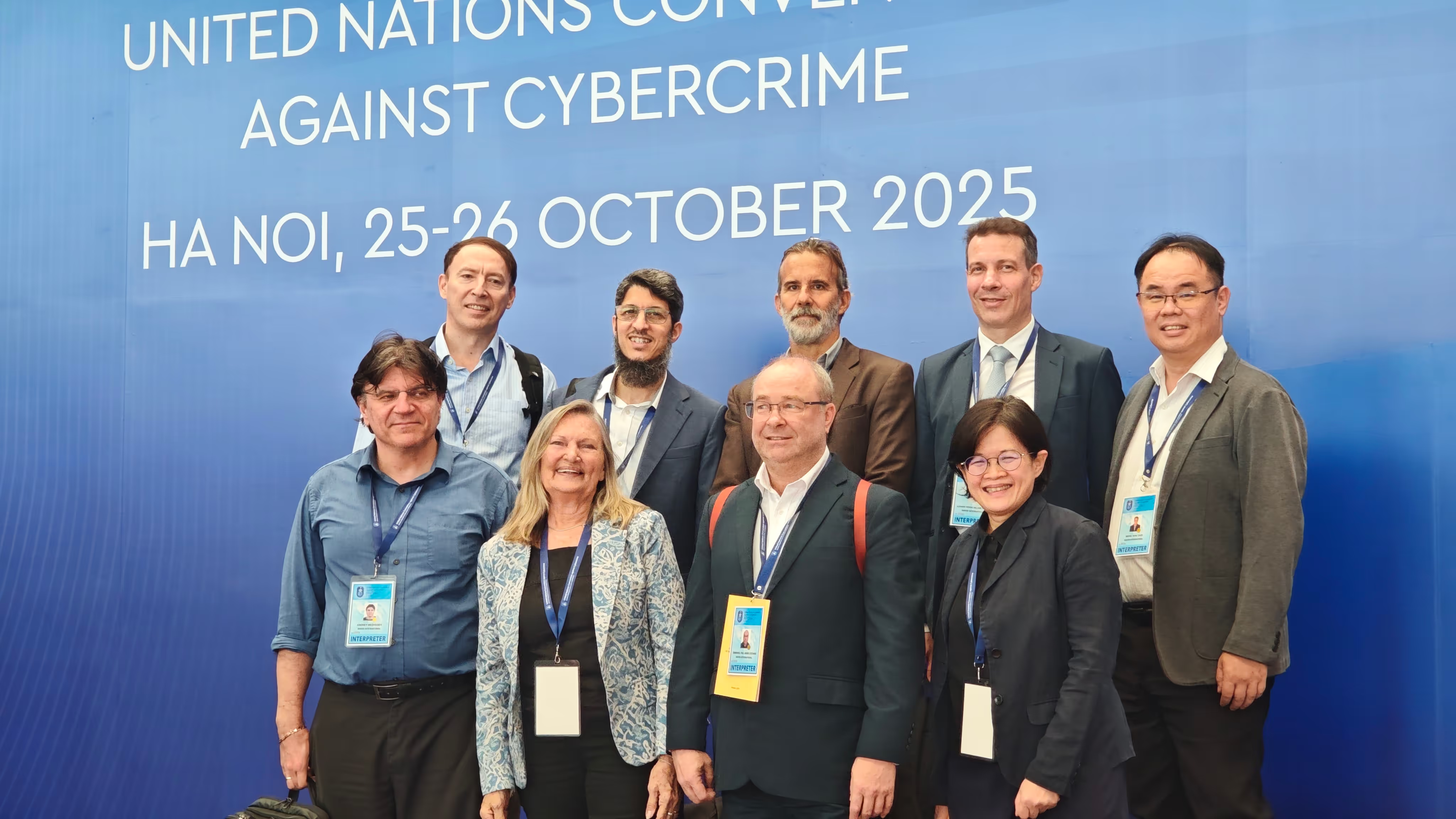
Government of Vietnam
Simultaneous interpretation for a high-level UN convening hosted by Viet Nam's Ministry of Foreign Affairs in October 2025.

Asian Football Confederation
A decade of interpretation at events across Asia, in remote and on-site formats.
.avif)
International Justice Mission
On-site and remote interpretation across regional, major, rare and endangered languages.
Frequently Asked Questions about Interpretation Languages
.webp)